About Me

My photo
A non-profit 501(c)(3) informal education program developed in an effort to introduce young men and women, ages 12-18, to marine science education through underwater exploration.

Friday, June 29, 2012

Most interesting thing learned about Belize and its reefs


Today I have spent 7 days in Belize. I have had an amazing time and learned a bunch. The diving has been unbelievable, and the hospitality has been incredible. The most interesting thing I learned about the island is that it is an atoll that was formed by the two crusts, the Caribbean and the North American crust, rubbing against each other called a slip fault and over time they formed small risen areas that eventually formed these atolls. Another thing I learned was the whole area of Glover’s Reef is a marine reserve that is regulated by the marine fisheries department. They as a whole regulate what activities can be done around the area like fishing, diving, or research. They try to make sure none of the coral is damaged and that conchs, lobster and fish are kept at a healthy level. It makes me happy to know that they are helping to keep this magnificent area preserved. Without them, this beautiful place would not have as many coral species and fish biodiversity that we have today. The most incredible thing I learned about the reefs in the surrounding area is that there are over 750 patch reefs. That is such an awe-inspiring number. The amount of reef sizes is way different from the reefs in Florida. There is a significant decrease of the sizes and abundance of reefs in Florida so being here makes me feel I have been highly privileged. I never want to leave and I want to know even more about other areas that surround this region!

~Sebastian DiGeronimo, St. Petersburg SCUBAnaut Chapter

Thursday, June 28, 2012

Coral Disease in Belize


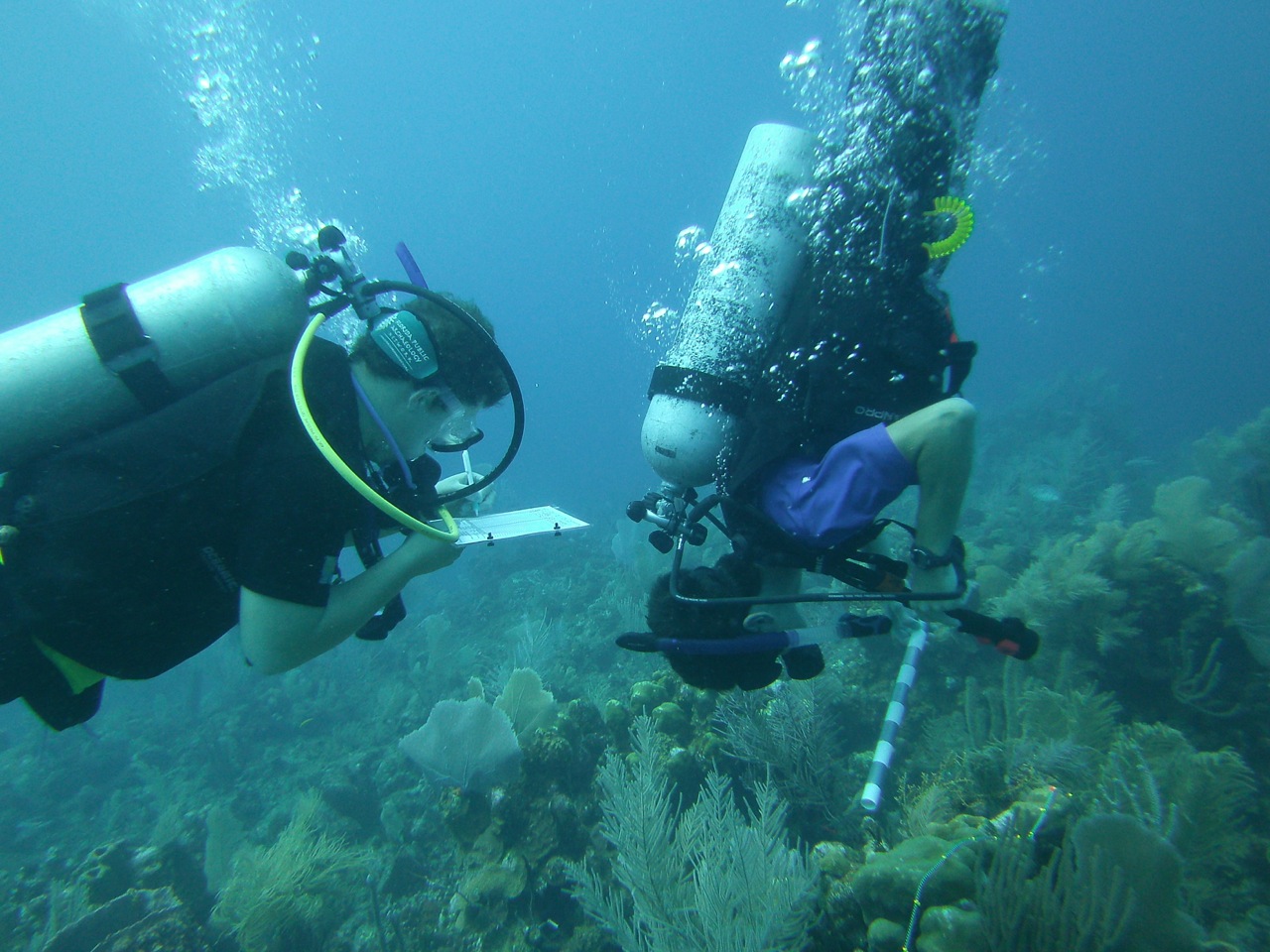
 Thought I would talk about my day today on Glovers Reef Marine Reserve. Today we did three dives, coming back to the island between each island for our surface interval. Between our first two dives, my science project partner (Brooke Liston) and I typed up the data that we collected the night before and started to plan how our project was going to come together as we collect more data.  Between dives, we took a canoe to a patch reef off of the island and completed two 10-meter AGRRA Belt Transects while snorkeling. Today we accumulated 6 more surveys towards our science project. For our project, we are correlating diseases and bleaching on corals to water depth. We are also taking other factors such as pH, temperature, salinity, and species of coral into consideration.  These environmental parameters are measured in triplicate at each location by 2 other ‘nauts, Jeremy and Danny.   
So far, have had some “problems” coming up with a large quantity of diseased or bleached corals in our data.  While this is great for the Belize coral population, it makes our project a little more difficult!  We do see diseases on almost every dive when swimming around but not always on our transect. We are looking for 8 types of diseases and I hope we have collected enough at each depth to make conclusions.

-Conner Hutchisson

Tuesday, June 26, 2012

Changes in fish diversity with depth

Over the past three days we have had the opportunity to dive parts of a single reef that all lie at different depths. At 90 feet, the reef is a vertical wall of coral. The wall is made up of various Montastrea spp. corals.  Generally, small fish are absent at this depth and larger fish are present.  Oddly enough on our most recent deep dive we found mainly smaller fish.  At 60 feet, the reef is the top of the wall.  Here, fish diversity and abundance was greater than at 90 feet. At 30 feet is the very top of the reef, where sand meets the edge of the reef, and the fish abundance and diversity is greatest. The smaller fish are much more abundant than larger fish.  Also, most of the juveniles are found at around 30 feet.

Monday, June 25, 2012

Day 3 of Our Glover's Reef Belize Adventure

It has only been day 3, yet us nauts have finished a ton of science! Every day we learn something new, something exciting, and something "unbelizeable" that will last us forever. For instance, last night we were blessed with a clear sky (one without rain) and were able to look up...up into a night sky like no other. Above our heads we could see a deep, black blanket with thousands of clustering stars twinkling down at us. Thanks to Carlie and her i-pad, we were able to locate the Ursa Major (the Big Dipper), the Polaris (the North Star), and other constellations, such as Virgo. Our nights are just as interesting as our days.

Today, we were given the challenge to learn about the Glover's Reef marine reserve and what exactly made it up. To start things off, a reserve is a given area protected by a government where nature can do what it does best, unharmed with little human interaction. Glover's Reef has been maintained by the Wildlife Conservation Society for three decades by a group of very hardworking people. In order to protect the reefs in the reserve, people are not allowed to fish unless they have a permit and poaching is out of the question. Although tourists can visit the research station here in Belize, there are certain areas that are restricted. With good reason too, because according to a staff member here, a major reason for this station was to help restore Nassau Grouper in the vicinity. A few of us have already fleetingly seen some and that's the way we'd like to keep it. Who knows what we will be able to see tomorrow?
~Jessica Silk

Sunday, June 24, 2012

Stormy morning but having a great time!


We woke up to a ferocious thunderstorm with rain and bright lightning.  Everyone in a hammock got soaked.

Even though there was a storm, the visibility during dives was still 60 feet +.  Corals at depth were flatter and smaller.  They have to collect sunlight so they need to have more surface area and they are smaller because they don't have as many nutrients.  Corals at shallower depths were more boulder-like.  Fish at depth compared to shallower dives were not as differing.  Gobies were more abundant at depth. 

At the end of our last beautiful dive we got to swim with 4 adult dolphins.  During the night we went over Powerpoints on Belize and Stars/Constalations.  On the dock we viewed them with amazement.  

~Sofia Alaniz and Makenzie Burrows

Saturday, June 23, 2012

SCUBAnauts arrive in Belize!


Brooke conducting an AGRRA point count survey
Hello, the SCUBAnauts have arrived in Belize! We got to drive though Belize city. We saw the poorest and richest parts of Belize. Since our currency is twice as strong, most of the Belize citizens are poor in our standards. After a three hour boat ride, we arrived at Glover's Reef Marine Research Center. We went on our first dive an hour after we arrived. It was off the dock in about twelve feet of water. Even though it was just a small patch reef, it was full of life. At home we have to go about thirty miles offshore to see the amount of coral and life we saw in twelve feet. The corals here are much bigger, and there is a greater diversity of fish and corals. We met the staff on the island and they are really friendly and helpful. Also, the food is delicious. We had a great first day, and we look forward to many more unbelizable days! 

~Ashley Hilbert and Brooke Liston, Tarpon Spring SCUBAnauts

Tuesday, June 5, 2012

Capitol Hill Ocean Week: NMSF Awards Dinner


Another wonderful night celebrating the oceans with an amazing group of role models for our next generation of ocean scientists, stewards and explorers.  To start off the night, our SCUBAnauts had the opportunity to meet one-on-one with Dr. Jane Lubchenco, the NOAA Administrator, and Dr. Kathryn Sullivan, the deputy administrator for NOAA.  Our youth greatly appreciated the time and the interest they took in learning about their student research projects.  The students, in turn, learned about some of NOAA's big initiatives and also had the opportunity to learn what it was like to be a NASA Astronaut from Dr. Sullivan (the first woman to talk in space).

Monday, June 4, 2012

Celebrating World Ocean Day!

The SCUBAnauts love the ocean! In celebration of World Oceans Day 2012 (June 8th), the nauts are taking on Washington D.C. for Capitol Hill Ocean Week (CHOW) hosted by the National Marine Sanctuary Foundation.  SCUBAnauts will discuss current ocean issues with Members of Congress and Congressional Staff, as well as experts from federal, state and local government agencies, industry, academia, and the nonprofit community.  SCUBAnauts International is a Global Learning and Observations to Benefit the Environment (GLOBE) U.S. Partner focused on collecting data in the marine environment.  During CHOW, SCUBAnauts will engage with students from around the world through virtual conferences to discuss ocean-related issues.  The goal of this program is to provide a diverse group of young men and women with the opportunity, knowledge and tools to become the next generation of ocean explorers, stewards, and scientists. 

Follow along as SCUBAnauts post their reflections throughout the week of June 6-9th, 2012.

PLEASE POST A COMMENT (no login required), Tell us why do you love the ocean, and what are you doing in celebration of World Oceans Day? (please include your geographical location e.g., St. Petersburg, FL USA).

Monday, May 14, 2012

Dive with Pierre-Yves Cousteau!

Today SCUBAnuats had a great day diving off the coast of Tarpon Springs with Pierre-Yves Cousteau!  Pierre Cousteau is an incredible ambassador for ocean conservation, and we look forward to continuing to work with you,  Cousteau Divers and the Canterbury Marine Science program in the future.  During the dive, SCUBAnauts assessed benthic cover, fish diversity and water quality using the Atlantic and Gulf Rapid Reef Assessment (AGRRA), REEF, and GLOBE protocols.  This dive was part of an ongoing monitoring effort by the SCUBAnauts to document reefs off the coast of Tarpon Springs.    

Saturday, May 12, 2012

Keeping our coastlines clean

On Saturday June 5th, SCUBAnauts of the St. Petersburg Chapter woke up early to host a Coastal Cleanup Bash at the Clam Bayou Education Center.  They invited families from the local community to come learn about local marine ecosystems and how they are damaged by marine debris.  Following presentations by marine scientists from the College of Marine Science, University of South Florida, youth collected debris found on the beach and within the mangroves.

Tuesday, November 1, 2011

Coastal Cleanup Bash: Nov. 12th 2011

DO YOUR PART TO KEEP OUR BEACHES CLEAN... BE A STEWARD OF YOUR LOCAL COASTAL COMMUNITY!

The St. Petersburg Chapter of SCUBAnauts International is hosting a coastal cleanup and native plant restoration for youth (ages 10-17) and their families at Clam Bayou on November 12th, 2011 from 8:30 a.m. - noon in St. Petersburg, Florida.  In addition to the cleanup and plant restoration, the event will include presentations and hands-on activities led local marine scientists from the University of South Florida.  Join us and learn more about your local marine and coastal environments, the effects of marine debris, and what you can do to help.  All volunteers will be provided with cleanup supplies and will receive a free stainless steel water bottle.  To register and obtain more information including directions to the education center, please email Ben Prueitt (bprueitt@scubanautsintl.org).

We are asking that all participants please register and complete a brief survey on marine debris.  The links to the surveys are below:
Event Registation
Marine Debris Survey

Wednesday, August 24, 2011

SciDay, Part 2

Part 2: Science Research Day

On their applications for the Science Research Day, many of the ‘nauts expressed interest in learning about sea turtles.  Lucky for us, SCUBAnauts has our very own turtle expert – Rhonda Bailey.  Ms. Bailey works for the Florida Wildlife Research Institute in St. Petersburg, focusing on turtle strandings and unusual mortality events.  Working with her, the ‘nauts learned how to accurately measure turtles and were able to see a lot of sea turtles that had been killed by the extreme cold weather last winter.  They also learned about bivalves from Sarah Stephenson, a scallop expert at FWRI.
Learning how to open a scallop

Using calipers to accurately measure turtles

Our last stop of the day was over at the USGS.  The ‘nauts listened to a presentation by geochemist Jen Flannery.  She gave a presentation on the purpose of the USGS (“Science for a changing world”) and went over some of the current projects at the St. Petersburg office.  Jen also showed the ‘nauts some of her work on the isotopes found in coral skeletons and plankton that have died and settled in the sediments.  The ‘nauts learned about how these basic measurements can be used to determine past climate change and that the earth’s climate has natural variability.
Listening to Ms. Flannery talk about climate change throughout history and how scientists measure it.
What did the 'nauts think about this experience?  In their own words:


We got to do some awesome things at the science research day.  I really enjoyed all of the events and people we met. My favorite was the plankton tow and identification.  I learned a lot during the microbiology with Ms. McDaniel, like separating split pea DNA.  Another cool thing was learning about the sea turtles and bivalves. All and all I learned a lot and got to know about specific jobs in the oceanography world.
-Mackenzie
Mackenzie identifying plankton with Sennai

On Saturday (the 11th), I was able to participate in an event where we did intriguing labs with different scientists relating to their different professions. We got to make a spectroscope, catch some zooplankton, and I learned how to shuck an oyster!!! We even found out how to extract DNA from a pea plant (we thankfully ate lunch before that one). By participating I gained new knowledge about bivalves, such as how a green scallop is an invasive species, and the differences between sea turtles. Overall it was a lot more interesting than I would have thought and it was way better than just staying at home! 
-Jessica

Jessica doing a plankton tow
I had a great time at the science research day at USF. We met many scientists and learned about their fields of work. One of my favorite scientists was Maria, she taught us about spectroscopes and we even got to take one we made home. I messed up a lot making mine but in the end it worked! Another scientist I enjoyed hearing from was Sennai. He informed us about plankton - zooplankton are animals and phytoplankton are plants. We even did a plankton tow, collected some, and examined them under a microscope. Lastly I really enjoyed the sea turtles with Rhonda. We learned how to take real stranding report. All in all, I had a really informative and fun day!
-Ashley
Ashley learning how to measure a sea turtle

Science Research Day, Part 1

On August 11th, a six SCUBAnauts from two chapters were able to participate in a Science Research Day put together by Carlie Williams, the Education Officer from the Tarpon Springs chapter.

The goal of SciDay was to show the ‘nauts some of the many different research projects going on in the Marine Science cluster in downtown St. Petersburg.  St. Pete hosts an amazing number of marine science-focused agencies.  These include USF College of Marine Science (many of our valuable volunteers are graduate students there!), the Florida Wildlife Research Institute (FWRI), U.S. Geological Survey Coastal and Marine Science Center (USGS). The scientists at these agencies are involved in a huge range of experiments such as biology, geology, ecology and much more.

The ‘nauts got the chance to learn from these researchers and see their personal projects.

First up was a presentation by Maria Vega-Rodriguez on how she uses satellites in her research.  Remote sensing is a very useful resource for oceanographers, allowing them to access data about the ocean on a very large scale and over long time periods.  The satellites can measure a lot of things including ocean color (indicating how much chlorophyll is in the water, measuring plankton blooms) and sea surface temperature. Sea surface temperature can be used to track currents or even help Maria to predict when coral bleaching might occur.  After learning about remote sensing, the ‘nauts got the chance to build their own spectroscopes, a simple method for separating light into it’s basic wavelengths.

The ‘nauts make their own spectroscopes which demonstrate that visible light can be broken down into parts (like a rainbow)

A picture of the 'nauts testing out their spectroscopes.
Sennai Habtes led a great activity where the ‘nauts used a net to do a plankton tow.  Plankton are any living organisms that can’t swim against the current, and are made up tiny little plants (phytoplankton) and little animals (zooplankton).  Many zooplankton are actually the baby larvae of bigger fish and animals that we like to eat (like tuna and lobster), so it’s really important to know what’s out there.  The ‘nauts were able to do their own plankton tows and then check out their plankton under the microscope.  Sennai challenged the ‘nauts to identify their plankton, and it was definitely difficult!

Ashley towing the plankton net along the seawall

Sheridan checking out some plankton underneath a dissecting microscope.  She's using a book about the plankton of the Gulf of Mexico to help her identify what she sees.

After lunch, the ‘nauts visited a microbiology lab to learn how marine scientists use DNA in their research.  Bacteria and viruses form the basis for many chemical reactions in the ocean, feed or cause disease in other organisms. The DNA in these microbes can tell us a lot what they are and what they do in the oceans because they’re too small to see and hard to work with in the lab. Dr. Lauren McDaniel demonstrated how to extract DNA from a sample.  After the ‘nauts learned how to get DNA out of the cells, Dr. McDaniel showed them how to visualize the DNA to see its quality and quantity.


Pulling out extracted DNA (the white stuff) with a Q-tip

Loading DNA into a gel to test the quality and size of it.

Stay tuned for Part 2!

Monday, August 15, 2011

Ask the 'nauts!


We ask all of the SCUBAnauts to keep a journal during our science expeditions.  This is both so they can take notes during lessons and to record their thoughts throughout the trip.  Here is a sample of some of their journal entries from the Bahamas trip.  Thank you to our trip helpers Alyx and Courtney for deciphering the ‘nauts’ handwriting and typing these up!

August 1, 2011 – Our Travel Day

“It’s very beautiful here on the island. Today I learned that there are over 700 islands that make up the Bahamas. I want to keep my eye and camera out on the acropora corals and all the neat creatures”
- Brooke Liston

“Learning new things makes me happy. Weird, but yes happy. We are learning about surveys and new dive stuff. I’ve learned so much; there are so many types of branching corals here.”
-Sofia Alaniz

August 2, 2011 – First Day of Diving

“Today we started diving; our first dive was at Plate’s reef. The visibility was amazing and it was more than 60 feet down. I saw PAST – yellow mustard hill coral, DLAB [Diploria labyrinthiformis] and a plethora of fish”
-Brooke Liston

“On the dive this morning I saw PCOL [Porites colonensis] and live MFRA [Montastraea faveolata] for the first time and they were everywhere. First dive was good and we saw some large snapper and grouper. On the second dive I saw a 7 foot Reef Shark up close with Kaedon. I saw an Indigo Hamlet and it is now my favorite fish. I thought the Tiger Grouper we saw was cool looking too; especially since it let us go right up to it.”
-Conner Hutchinson 

“My dive buddy (Conner H.) and I dove around, watching other people observe coral, and when we looked up we saw a 6-7 foot Reef Shark! There was also a 2 ½ foot Tiger Grouper and a lot of other awesome fish and corals.”
-Kaedon Hamm

“I have to say that the best dive was for sure dive number 3 at a site called “Shark Alley,” it lived up to its name. We saw four Caribbean reef sharks; it was probably the highlight of my trip, seeing sharks in their habitat is exactly why I wanted to start diving on top of my love for the ocean.”
Connor Waugh

“The best dive was “Shark Alley” during shark week, it was amazing. Six sharks were circling me and Ashley while we were doing point count. The sharks were so cool, one had a hook on both sides of its mouth. The last dive was in 4-12 feet of water there was a ton of dead Elkhorn Coral and some recovering.”
Colin Cassick

“Observation 60 foot dive, visibility perfect. It was a huge and I mean huge reef. The second was a 45 foot dive in “shark Alley,” I saw like 10 Caribbean sharks and got a picture with one. I also did point count on this dive. For our 12 foot dive it had really nice Elkhorn Coral [Acropora palmata] all over.”
-Ashley Hilbert

“Day 2 I saw two huge Cubera Snapper. I also saw 3 huge grouper and 4 Caribbean reef sharks; the “Shark Alley” was the coolest. One of the sharks had a hook in its mouth that had to be at least a 17/0 hook. The last dive was only 10feet and I really could’ve snorkeled it, but I really wanted to get in another dive.”
-Tyler Harder

August 3, 2011 - Second (and last) Day of Diving

“We went to “Ben’s Blue Hole” for the 3rd dive. Connor and I were doing coral surveys when a curious grouper came up to us to see what we were doing. He was so close that we actually petted him. We went to “Picasso’s Gallery” and saw another reef shark that swam under us during our buoyancy stop.”
-Kiana Hamm

“The second dive had 3 sharks and they came really close. As the day went on I found myself knowing more and more fish. The 3rd and 4th dive were really amazing, it is a lot better diving here than in Florida.”
-Danny Alaniz

“Today we had to do fish surveys and I learned how to identify Black Grouper, because they are a little confusing. On the 3rd dive at “Ben’s Blue Hole” there were 2 sharks that were following us and came within 4-5 feet of us!
-Alex Coronado

“The shallows had lots of branching corals that had the ability to move with the ebb and flow of the tides, as opposed to in the deeper water where there is less tidal action. The second dive was at “Papa Doc’s Wreck” and my buddy Sofia and I conducted our point count survey. On the two afternoon dives it was cool to see two invasive lionfish in the wild as well as several rays (“Ben’s Blue Hole”) and some squirrelfish (“Picasso’s Gallery”). Overall it was a great trip, even though the stupid weather caused it to end early.”
-Jeremy Koch

Belated blot post and Bahamas wrap-up


As many people know by now, the Tarpon Springs Chapter’s summer trip to the Bahamas got cut short by Tropical Storm Emily.  After our second day of diving on Wednesday, we all returned to our rooms to find notes on the door saying that our original departure date of Friday wasn’t going to work anymore.  The ship we were planning on taking home from the Bahamas had canceled its run on Friday in preparation for the tropical storm slowly making it’s way north from the Caribbean.

Our only options were to come home a day early (cutting out an entire day of diving!) or stay for a few extra days. Since we would have to pay for those extra days and none of us wanted to ride out a potential hurricane in the Bahamas, the chapter leaders opted to head home the next day.  We were all a little bummed but it was the only best choice.

Because we missed out on our third day of diving, we didn’t get to do our final rotation of surveys.  The three basic surveys we use look at fish, corals, and bottom types.  The buddy teams each focused on one of the survey methods for one day, using their multiple dives to ask questions and learn the details of the method.  The next day they’d switch to a new survey technique.  This way, the ‘nauts are able to learn each survey technique in-depth and experience all of them by the end of the trip.  Or at least that was the plan! Being familiar with 2 of the 3 surveys is still pretty good, and our science leaders will make sure everyone catches up on the one they missed.

On the ferry ride back to Florida, the ‘nauts sat down to take their post-trip assessment.  This is the same set of questions we gave them on the ride over, and many of the ‘nauts struggled to answer the questions.  We use the pre-trip assessments to check the current knowledge base of the ‘nauts and to show them what they’ll be learning over the course of the trip.  The post-trip assessments document how much they’ve learned in just a few days and allow us to show them their improvement.  We’re so busy diving on the trips, the kids don’t always have a chance to reflect their new knowledge.

All of the ‘nauts showed a lot of improvement on their tests, and we know they all had a great trip.  Even though we missed out on our last day of diving, we’re still thankful for the two beautiful days of diving we did get to experience.  Great dives sites, a great dive crew, and very spacious boat.  Thanks again to the Viva Wyndham resort and dive shop for helping us have a fantastic summer science expedition!

-Julie Galkiewicz
Chief Scientist, Tarpon Springs Chapter

Tuesday, August 2, 2011

Science dives in the Bahamas

Our second day on the island and our first day of diving!

Everyone went to bed really early last night after our looooong day of traveling.  So we were all ready for breakfast at 7 am.  Everyone, especially the teen-aged boys with endless appetites, is enjoying the buffet food.  After eating bacon, french toast, cereal and fruit, we all headed over to the dive shop.

Because we’re such a large group (20 divers!), we’ve basically taken over the dive boat for our three days of diving. We’re doing two dives every morning and afternoon on different reef.  The dive boat here is so nice for large groups – there’s plenty of space for all our gear and the science equipment we bring on board too.  I’m sure we got some funny looks from people as we were loading up.

Colin using the whirling hygrometer to figure out how humid the air is. This is only one of many pieces of science gear we brought with us.
Our first dive was a simple observation dive, to familiarize everyone with the reef.  The ‘nauts got to see how different these tropical Bahamian reefs are from our typical reefs in Tarpon Springs.  They were all amazed at the depth (more than 60 feet), the number and types of fish, and the strange new corals.

Our second dive was to a shallower site so we could start doing our scientific surveys.  Each of the buddy teams was assigned to a survey (fish, coral, or point count) for the day.  The Science leaders wanted to make sure that each ‘naut had a chance to do the same survey a few times in a row to really understand how it works.  Tomorrow the ‘nauts will switch to new survey method and work on that all day.

 I think the favorite dive of the group so far was our third dive of the day, visiting Shark Alley.  This spot is where a lot of dive boat operators come to show tourists sharks.  I was very glad to hear that the Viva Wyndham dive crew doesn’t chum the waters to get more sharks to the area – chumming is a bad idea because it teaches sharks to associate swimmers with food.  We were able to see lots of Caribbean reef sharks just cruising by.  They barely noticed we were there, but we all got to see them up close!

Our final dive for the day was on a very shallow site - my dive computer turned off a few times because it assumed I had surfaced and finished my dive.  This site had a lot of large corals including a big stand of Elkhorn, a very rare coral.


To wrap up the day, our evening science lesson focused on reflecting about what we learned today.  Everyone got a chance to share three things they saw underwater that they already knew and three things that were new to them.  It was great to hear that some of the fish and corals they saw on the first dive that they didn’t know were easily identifiable by the end of the day.  The ‘nauts also got to share advice about their challenges learning the new survey techniques.

Cross your fingers for us that Tropical Storm Emily stays away for the rest of the week!

-Julie Galkiewicz
Chief Scientist, Tarpon Springs Chapter

Monday, August 1, 2011

The SCUBAnauts travel to the Bahamas!

Today was our travel day, and it was long and difficult. We started off by driving from Tampa Bay to Fort Lauderdale overnight, with several of the parents driving vans and cars loaded with gear, luggage and kids. It was definitely an all-nighter for those parents and some of the kids who spend the night talking instead of sleeping!


Ashley, Connor, and Kaedon taking their pre-trip assessment tests
on their cruise to Grand Bahama.
 
We got to Fort Lauderdale at 4:30 am and ate breakfast at a Denny’s before heading to Port Everglades. We had chosen to take a small cruise ship over to Grand Bahama instead of flying due to cost and because we wanted to fit in a few more dives on our last day. All of our divers know that you can’t go diving 24 hours before a flight, so we would’ve had to cut out afternoon dives on our last day. Taking the cruise ship got around those problems, but we ran into a few more challenges...


As we are all well aware of now, any kids under the age of 18 who are traveling out of the country need written consent from their parents. Unfortunately, none of our parent-less travelers had those specific forms. So a mad dash ensued with the ‘nauts frantically calling their parents at 7 am trying to get them to fax or email over proof that would allow us all to travel as a group. A few tense minutes passed, but we finally got everyone on-board the ship.


Alex getting excited about the field guide to the Bahamas!


As we all breathed a sigh of relief and enjoyed the breakfast buffet (breakfast number 2 for the day if you were counting), the ‘nauts got to work on their pre-assessment tests. Carlie, the Education Officer, and I use these tests to see how much the ‘nauts already know about various topics, including chemistry, biology, geology, history, geography, and dive skills. As we go through our week, the kids will be learning more and more about each of these topics, and they’ll get a post-assessment test to see how much more they know after our science expedition.


The cruise lasted about three hours, and we were all happy to finally reach the hotel. This is different from any other SNI summer trip because we’re staying in an all-inclusive resort. It’s very nice that our meals are cooked for us and that we don’t have to provide a lot of the basics. But we’re not here on vacation – this is a science expedition! The kids are expected to attend science lessons every night, write in their journals, and prepare for each day.


Colin stunned by the new things he has learned from
the field guide.

Today presented a lot of challenges, a lot of “hurry up and wait” moments, and some exasperation. But we all made it to the Bahamas in one piece, we have a gorgeous view of the ocean, and our dives are all lined up for tomorrow – the first real day of science. Can’t wait to see what the rest of the week holds!


-Julie Galkiewicz
Chief Scientist, SNI Tarpon Springs

Wednesday, July 27, 2011

Ocean for Life 2011

Thirty high school students from the Greater Middle Eastern and Western countries participated in Ocean for Life (OFL), a program to increase cultural understanding through ocean science, from July 14-26, 2011. The students studied at NOAA's Channel Islands National Marine Sanctuary in California. The Ocean for Life program is a partnership among the National Oceanic and Atmospheric Administration's Office of National Marine Santuaries, SCUBAnauts International, the Global Learning and Observations to Benefit the Environment (GLOBE) Program, and the National Marine Sanctuary Foundation.

The themes of Ocean for Life are: a sense of place, interconnectedness, and ocean conservation and stewardship.

Sense of Place
Photo: Jim Webb, National Geographic Photo Camp OFL 2011

We visited the Chumash Discovery Village where we met the people and learned about the culture and ways of the first people of the Channel Islands - the Chumash.  They taught us a few of their native songs and words in their language.  They told us how their people relied on the ocean's resources for food, supplies, and money.

Brooke Liston, a Tarpon Springs SCUBAnaut and participant of the 2011 OFL Program, investigating the touch tanks at the REEF Facility at University of California at Santa Barbara (UCSB).

We also learned about the animals that inhabit the Channel Islands National Marine Sanctuary.  We camped for three nights at the University of California Reserve Field Station on Santa Cruz Island and kayaked and snorkeled through the breathtaking kelp forests.  It was amazing how the field station was surrounded by the natural beauty of the island.  It also was amazing to see so many stars at night. It is the epitome of how beautiful the world can be when humans are respectful and use moderation. It was wonderful to get away from the busy and frantic mainland and to connect with nature and yourself.


Interconnectedness

Native plant restoration on Santa Cruz Island
We learned that we are all connected by the ocean and that all of our actions affect the ocean.  Even if someone littered in Michigan, it could be carried to the Gulf of Mexico, across the Atlantic, and delivered to the Mediterranean, affecting people in Lebanon.  We also learned how the land and water are interconnected.  The plants and the animals living on Santa Cruz island are dependent on a clean water supply and, in turn, a healthy native plant population is important for keeping the water clean.  While staying on Santa Cruz Island, we had the opportunity to work with Growing Solutions on native plant restoration.   


Ocean Conservation and Stewardship

Ocean for Life has a huge focus on ocean stewardship.  During the program, we had two beach cleanups.  One of them was with a group of local fourth graders and we taught them about the importance of keeping the ocean clean.  All of us are going to plan ways to educate people about the ocean in our respective communities.  We learned a lot about problems related to carbon dioxide (CO2), in particular ocean acidification.
OFL students learn about the effects of ocean acidification on marine organisms at the Marine Science Institute at UCSB


OFL students measure nitrates at Hendry's Beach, CA


We also collected a lot of GLOBE data.  This was a treat for me because I have collected tons of GLOBE data with SCUBAnauts International.  I had the chance to compare the data from the Florida Keys National Marine Sanctuary with the data from the Channel Islands National Marine Sanctuary.  We also compared our GLOBE data with GLOBE data collected in Bahrain. 


The Ocean for Life Experience

Brooke learning how to put on and wear a hijab
Photo: Ibrahim Al-Sulaiti, Qatar, Ocean for Life 2011
During the program, we took thousands of pictures to collect and put into our Media Projects.  We were assisted by National Geographic photographers and American University film students who taught us how to make photographs and not just take them.  My group's project was Cultural Understanding.  It was perfect for my group because we were so ethnically diverse.  We came from Egypt, Lebanon, Qatar, American Samoa, and the United States.  Overall, the 2011 Ocean for Life project brought together 12 Western students from Canada, the United States and American Samoa with 13 students from the Greater Middle East representing Bahrain, Egypt, Kuwait, Lebanon, Pakistan, and Qatar.  It was great to have so many cultures giving us the chance to understand and immerse ourselves into each others' cultures.  My roommate and fellow group member, Amira from Egypt, taught me how to put on a hijab.  It was an amazing experience.

Ocean for Life was a moving experience for me.  I learned a lot about the ocean, other cultures and myself.  We were scared that we would not be accepted by people from other cultures, however we were so wrong.  We grew very close to one another and left with many new sisters and brothers who share a lover for each other and the ocean.  It is now our mission to teach people ocean stewardship and cultural understanding.

~Brooke Liston, Tarpon Springs SCUBAnaut and 2011 OFL participant

Thanks to all of the 2011 sponsors/donors that made this program possible including the Qatar Foundation International, WAFRA Investment Advisory Group, Inc., The Ettinger Foundation, Ellmar Foundation and One World One Ocean.

For more information on the 2011 Ocean for Life Program and Experience, check out the following links:

OFL Facebook Page

OFL Media Projects

National Geographic Photo Camp - 2011 Ocean for Life

QFI Blog